E-Mobility

The truth about electric cars: 10 persistent myths put to the test

Too expensive, not enough range, a poor carbon footprint: some claims about electric cars persist that were partly true ten years ago but are outdated today. Others still hold true, at least in part. We've checked ten common prejudices and tell you what's left of each one.

author image

Written by Livia on 26.09.2023

A person wearing sunglasses stands in front of a Audi S6 e-tron on a city street.

Myth 1: “Electric cars are expensive.”

Reality: Quite the opposite – think lifetime and total cost. 

Times have changed: electric cars are becoming more affordable, mainly because battery costs have fallen sharply over the last decade. When it comes to incentives, it's worth checking your own canton: some still offer discounts on motor vehicle tax or contributions towards charging infrastructure, but the rules vary considerably and change all the time. The running costs of an electric car are lower over its lifetime, and if you look at the TCO (total cost of ownership), an electric car is an investment that pays off. The biggest savings potential in running costs lies in energy, service and maintenance costs. This is where electric cars have significant advantages over combustion engines.

And there's evidence for this: the SwissEnergy study “Total cost of passenger cars” concludes that in all four vehicle categories examined, electric cars are cheaper to run over the period of ownership than comparable combustion engine cars.

Myth 2: “Electric cars have a short range.”

Reality: Today, electric cars can travel 300 to 900 km on a single charge.

Depending on battery size, tyres, body type and above all driving style, modern electric cars can easily cover several hundred kilometres on a single charge today (3). Planning a longer trip? Long distances have long been possible with an electric car too. In Switzerland, there are around 18,400 publicly accessible charging stations, including almost 600 fast-charging sites with charging capacities of between 50 and 350 kW. The number of charging stations is growing steadily, both in public spaces and in private households. Fast-charging technology is also advancing, which is reducing charging times on the road even further.

Myth 3: “Electric cars are slow to charge.”

Reality: Fast-charging stations add up to 300 km of range in just 20 minutes. 

Charging isn't the same as refuelling. Electric cars are usually charged where they're parked for longer periods – at home or at the office. That's why charging time often doesn't really matter. On a longer trip and need to charge quickly? No problem. Switzerland has a growing fast-charging network with almost 600 stations and up to 20 DC charging points per station. Charging capacities at fast-charging stations now range from 50 to 350 kW, which corresponds to 250 to 750 kilometres of added range per hour (2). Under ideal conditions, you can charge your battery from 10 to 80% in just under 25 minutes (4).

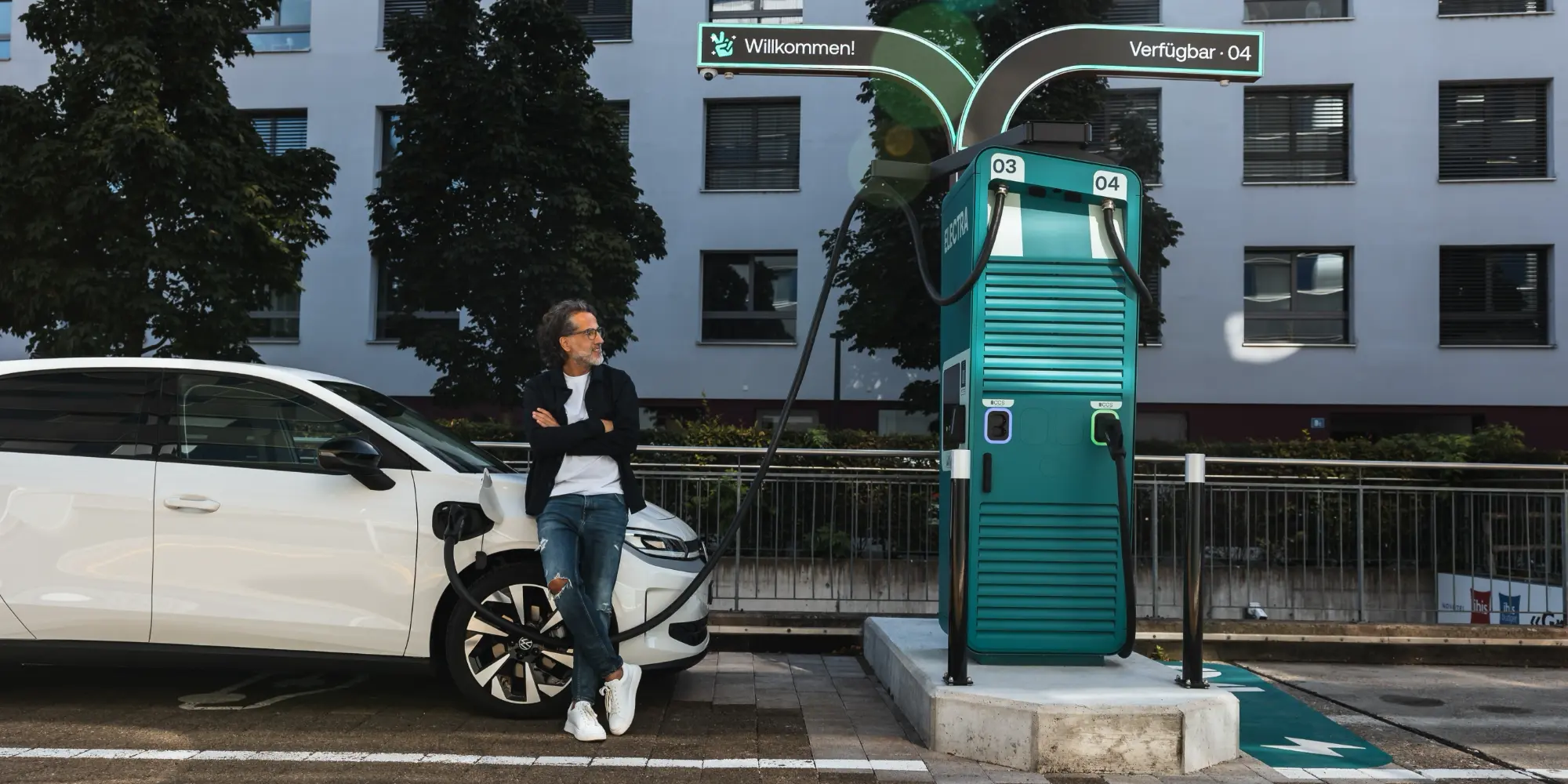
A man leans on a white VW ID. Polo charging at a station.

Myth 4: “The battery has a short lifespan.”

Reality: Lithium-ion batteries are reliable and durable. 

The lifespan of your electric car battery depends on how often it is charged and discharged. Car manufacturers also offer long warranties covering long distances. VW, for example, guarantees that after eight years or 160,000 km the battery will still have at least 70% of its usable capacity (4). The batteries are actively cooled or heated, and the battery management system balances the voltage of the individual cells to ensure optimum performance. And what happens when the battery gets too weak for the car? It's not hazardous waste. As a rule, it gets a second life as stationary buffer storage, for example for solar power. Only after that, with an expected total lifespan of 20 to 25 years, does it go for recycling. Modern processes now recover a large proportion of the materials.

Myth 5: “Electric cars are not safe.”

Reality: Cold and wet conditions pose no danger to your electric car either.

Electric cars guarantee the highest level of safety thanks to special safety systems. For example, the battery's power supply is cut off immediately in the event of an accident. Statistics from several countries also show that electric cars don't catch fire more often than combustion engine cars. One difference remains: if a battery does catch fire, it's harder to put out, which is why fire services have their own procedures for it. The heavy underbody (battery) minimises the risk of rolling over, and thanks to the small electric motor, no heavy engine block is pushed into the passenger compartment in a crash. Charging in the rain, for example, is also completely safe: if the battery and charging station meet the standards, no current flows until a secure connection has been made. Your electric car is also safe during a thunderstorm, just like any other car (4).

Myth 6: “Electric cars do nothing to improve the environment.”

Reality: No other type of drive has a better carbon footprint than the electric car.

It's true: an electric car starts out with a carbon debt. Producing the battery causes additional emissions, which is why an electric car lags behind a comparable combustion engine car in terms of CO2 when it's delivered. Over its entire lifetime, however, an electric vehicle produces only half the greenhouse gas emissions of a petrol car (3). So electric cars make an important contribution to climate protection. And as the share of green electricity grows, they become even more environmentally friendly. In Switzerland, electric cars become more environmentally friendly than combustion engine cars after only a short distance, thanks to a clean electricity mix with a high share of hydropower (4). Even better and the most sustainable option of all: charging your electric car with your own solar power. 

Myth 7: “Electric cars are anything but electrifying.”

Reality: 0 to 100 km/h in under 4 seconds with your electric car. 

No clutch to pull away and from standstill to top speed in just a few seconds. That's what powerful electric motors offer – butterflies in your stomach guaranteed. The absence of a roaring engine has little to do with performance, but perhaps a lot to do with the persistent myth. By the way, the acceleration process can also be reversed to slow the car down: in regenerative mode, the motor works as a generator brake, feeding energy back into the battery. Win-win.

Myth 8: “Electric cars overload the power grid.”

Reality: We could easily cope with an electric car boom.

If the entire Swiss passenger car fleet were electric, the country's electricity demand would rise by around 10 to 15%. That's a manageable order of magnitude, but it does require further expansion of production and storage. Consumption isn't evenly distributed, though: what matters is less the annual amount than when charging happens. AMAG, Clyde's parent company, is involved in expanding renewable energy. When it comes to another challenge – ensuring grid stability – electric vehicles could even be part of the solution. The keyword: bidirectional charging. The vehicle battery acts as intermediate storage for electrical energy (e.g. to store surplus solar power), making it possible to cook with renewable energy in the evening, even when the sun has stopped shining.

Myth 9: “There aren't enough raw materials.”

Reality: There's enough lithium, and less and less cobalt is being used.

There are sufficient raw materials, and batteries are constantly being further developed and sustainably recycled. The proportion of cobalt is set to be significantly reduced in the medium term and brought down to zero in the long term. With the known lithium deposits and today's technology, batteries could already be produced for billions of electric cars (4). While the combustion engine has been developed over decades, e-mobility is still in its early days. There's still plenty to look forward to in battery development.

Myth 10: “Electric cars are a danger to cyclists and visually impaired people.”

Reality: Not with the artificial driving sound at low speeds.

Because they run so quietly, electric cars make a significant contribution to reducing traffic noise and improving public health. They also help reduce costs that would otherwise be passed on to uninvolved third parties. The added value of quiet e-mobility benefits not only electric car drivers but society as a whole. To ensure that electric cars can be heard by people with impaired vision and by cyclists, they must be fitted with an acoustic warning system, the Acoustic Vehicle Alerting System (AVAS), which emits an artificial driving sound up to a speed of 20 km/h (5). At higher speeds, aerodynamic noise and tyre rolling noise are louder than the artificially generated sound.

Just try it.
Your way.

Start your journey into e-mobility now, risk-free: insurance, service, taxes and, if you want, even electricity in one monthly rate.

Other electrifying articles: