Inspiration

Car costs in Switzerland: how much does a car cost per year?

In Switzerland, a car costs around CHF 11,100 a year, or about CHF 926 a month. That's what the TCS calculates for its 2026 model car: a new car costing CHF 45,000, driven 15,000 kilometres a year – which works out at 74 centimes per kilometre.

author image

Written by Laura on 06.11.2024

A gray CUPRA Raval is parked on a concrete surface. A person in a red jacket and jeans walks past in the foreground.

What stands out: the purchase price is only part of the equation. The biggest item is depreciation – and that never appears on a bill. If you want to keep your car costs under control, you need to look at the total costs over the period of ownership: the total cost of ownership, or TCO for short.

How much does a car cost per year?

Every year, the TCS calculates the costs of a model car. For 2026, the calculation comes to CHF 11,112 per year – based on a new price of CHF 45,000 and 15,000 kilometres driven. That works out at:

Electric vs. hybrid: The direct comparison

Car costs, 2026 model car

per year

CHF 11,112

per month

around CHF 926

per kilometre

74 centimes

These figures apply to a combustion engine car with average use. If you drive less, you pay more per kilometre, because the fixed costs are spread over fewer kilometres. But what running costs make up this amount?

Car running costs: what do they include?

When buying a car, the focus is usually on the purchase price – in black and white, clear and simple. But what about all the other costs that come with a car?

Running costs are all the expenses that arise after you buy the car. They fall into two groups: Fixed costs arise no matter how much you drive – even if the car stays in the garage all year. Operating costs, also known as variable costs, depend directly on the kilometres driven.

Fixed costs:

  • Depreciation (loss of value)

  • Subscription or leasing costs

  • Road tax

  • Vignette

  • Parking space or garage

  • Car care, such as car washes

  • Insurance (third-party liability is compulsory)

  • Interest on the capital invested

Variable costs:

  • Fuel or electricity

  • Tyres

  • Service and oil changes

  • Repairs

Around 58% of total costs are fixed costs and around 42% are operating costs. So the car already costs around CHF 6,400 a year before it has driven a single kilometre.

The biggest cost item: depreciation

What drives car costs the most never appears on a bill: depreciation. A new car typically loses 40 to 50% of its value in the first three years – for a CHF 45,000 car, that's CHF 18,000 to 22,500, or CHF 500 to 625 a month. More than fuel, insurance and servicing combined.

This cost only applies if you own the car. With leasing and subscriptions, the provider bears it and it's factored into the monthly rate. That's what makes comparing a purchase with a monthly rate meaningful in the first place: a CHF 800 rate isn't more expensive than a car you've bought – the costs are just spread differently.

How do the costs of electric cars and combustion engine cars differ?

According to a study by SwissEnergy (4), the costs of mid-size, luxury and SUV electric vehicles are lower over the period of ownership than those of their combustion engine counterparts. Despite the often higher purchase price – why is that?

Service costs of BEVs and ICEs compared:

Electric cars generally have lower maintenance costs than combustion engine and plug-in hybrid cars: no oil changes, no timing belts, no exhaust system – and thanks to regenerative braking, the brakes last longer too.

Tyre costs of BEVs and ICEs compared:

Contrary to popular belief, tyre costs are no higher for electric cars than for combustion engine cars.

Depreciation of BEVs and ICEs compared:

This is the biggest cost driver – and this is where electric cars are currently behind. An analysis of ten pairs of models from the same brand shows that the electric model lost more value after three years in all ten cases. The VW ID.3 lost 51.2%, compared with 41.3% for the equivalent Golf.

The reason isn't wear and tear, but the pace of development: new models offer more range and faster charging, which quickly makes older vehicles look dated. On top of that, used car buyers are wary about the battery's condition.

For the overall calculation, this means: when you buy an electric car, depreciation weighs more heavily than with a combustion engine car. If you don't want to take on that risk, you're better off with a monthly rate – where the provider bears it.

Fuel and electricity costs of BEVs and ICEs compared:

Per kilometre driven, electricity is usually cheaper than petrol or diesel, which means that energy costs are lower for electric cars.

All in all, electric cars are cheaper to run over the period of ownership in most vehicle categories: what they lose in depreciation, they make up for in energy, servicing and taxes. The more kilometres you drive each year, the more pronounced this effect becomes.

Purchase, leasing or subscription: where the costs arise

Purchase

Leasing

Subscription

Upfront costs

Full purchase price

Often a deposit

None

Depreciation

You bear it

Borne by the lessor

Borne by the provider

Insurance, service, tyres

Separate

Usually separate

Included in the rate

Commitment

None

Several years

Short terms

Predictability

Low

Medium

High

None of the three models is fundamentally the cheapest. If you drive a car for a long time and maintain it yourself, buying gets you furthest. If you want predictability and a short commitment, you pay a premium for it – and get a budget you can plan.

Clyde's electric car subscription: what's included in the rate

Clyde's monthly rate includes insurance, service, tyres including storage, taxes, registration, the vignette and additional drivers. Electricity can be added if you want. When buying or leasing, you have to add these items separately – and that's exactly where the difference arises between the rate on paper and what actually leaves your account at the end of the month.

If you choose the “Premium – with electricity” option when configuring your electric car subscription, electricity is included in your monthly rate whenever you charge at one of the many public charging stations in our partner charging network in Switzerland and throughout Europe. If you charge privately, i.e. at home or at work, we compensate your electricity consumption with a credit of CHF 0.30/kWh (significantly more than local electricity suppliers' tariffs) in the form of vouchers that you can offset against your next monthly rate.

From a TCO perspective, this is very attractive – and it's why popular electric cars at Clyde are cheaper than comparable combustion engine cars bought through traditional channels.

Example: VW ID.3 on subscription vs. VW ID.3 on lease vs. VW Golf on lease
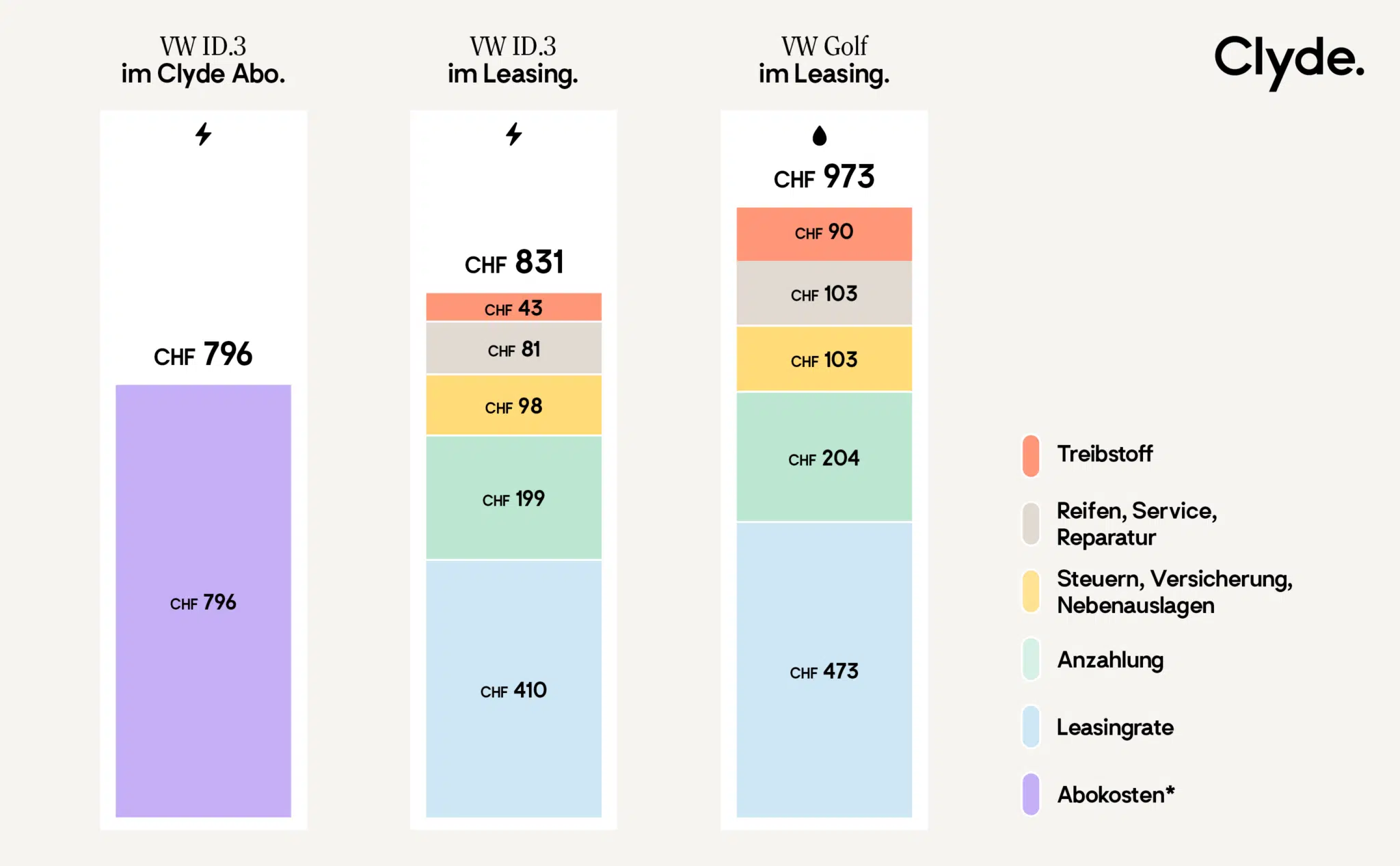
The chart shows the monthly costs of a VW ID.3 on a Clyde subscription compared with leasing the same model and with leasing the VW Golf, a combustion engine model comparable to the ID.3. It clearly shows that Clyde's electric car subscription is the cheapest option at CHF 796 a month. These subscription costs are based on the assumption that the ID.3 is charged 100% privately. Even if the vehicle is charged 50% or even 100% publicly, Clyde's electric car subscription remains the cheaper alternative to leasing.

How Clyde can offer such affordable electric cars

Clyde is a subsidiary of AMAG and sources its vehicles on correspondingly favourable terms. The vehicles are purchased within AMAG at attractive prices, which feeds directly into the pricing of our electric car subscription. On top of that, Clyde buys vehicles, insurance, tyres and many other services in large volumes and operates an extensive fleet. This results in significantly better conditions than individuals could get on the market.

Clyde also focuses on vehicles with up-to-date features. This deliberate focus keeps costs low without compromising on comfort or technology. While individual configurations and extras often drive up prices with leasing, Clyde's electric car subscription stays fair, transparent and affordable – making e-mobility accessible to everyone.

Car costs in Switzerland: the conclusion

1. Whether you buy, lease or choose an electric car subscription from Clyde: think carefully about which car offer you go for, and get an overview of the total costs of a car in advance. What looks lucrative at first glance often looks different on closer inspection.

2. The figures show that, over the entire period of ownership, electric cars are ahead of combustion engine cars when it comes to car costs.

3. With its simple, flexible and sustainable electric car subscription, Clyde gives customers maximum freedom compared with buying or leasing – and if you have a solar PV system, it pays off twice over.

Frequently asked questions

For its 2026 model car, the TCS calculates CHF 11,112 per year – around CHF 926 per month or 74 centimes per kilometre. This is based on a new price of CHF 45,000 and 15,000 kilometres driven per year.
Fixed costs such as depreciation, insurance, road tax, the vignette, parking and interest on capital arise regardless of how much you use the car. Operating costs such as fuel or electricity, tyres, servicing and repairs depend on the kilometres driven. Fixed costs make up around 58% of total costs.
Depreciation. A new car typically loses 40 to 50% of its value in the first three years – with a purchase price of CHF 45,000, that’s more than fuel, insurance and servicing combined.
Over the full ownership period, yes. A study by EnergieSchweiz concludes that electric cars have lower total costs in all four vehicle categories examined. Charging at the household tariff alone brings energy costs to roughly half.

Sources:

Household spending: Federal Statistical Office

Car costs: TCS kilometre costs, 2026 model car

Underestimated running costs: Mercator study

Total cost comparison: SwissEnergy, study “Total cost of passenger cars”

Depreciation: Carvago analysis, March 2026

Just try it.
Your way.

Start your journey into e-mobility now, risk-free: insurance, service, taxes and, if you want, even electricity in one monthly rate.

Other electrifying articles: